The beauty of two worlds.
In the modern world of skincare, we encounter two fascinating approaches from East Asia that could not be more different, yet both are rooted in centuries-old Eastern traditions.
While Korean beauty culture captivates with radiant innovations and an almost overwhelming abundance of products, Japanese beauty philosophy celebrates the quiet power of reduction. It is the story of More and Less, of acceleration and contemplation, of visible perfection in performance and subtle health.
Both approaches stand in stark contrast to European, science-based dermatology, which focuses on clinically tested active ingredients and medical evidence. But what lies behind these different philosophies? We immerse ourselves in the worlds of two beauty cultures that can teach us how diverse the paths to beautiful skin can be.
The Philosophy: Innovation Meets Tradition
K-Beauty presents itself as a dynamic laboratory of skincare. Here, trends are not born—they explode. The Korean cosmetics industry is driven by an insatiable urge for novelty: new textures, new active ingredients, new promises. All for the immediate wow effect.
The famous ‘Glass Skin’—porcelain-smooth skin that reflects light like a polished surface—is no accident, but rather the result of intensive care rituals and sophisticated layering of various products. It is an aesthetic of the visible, the immediately achievable. K-Beauty promises not only health, but visual proof of this health.
Glass Skin is not just a trend—it is a philosophy of perfection that finds its manifestation in every serum, every essence.
J-Beauty, on the other hand, breathes a different air. Here reigns the principle of ‘Ma’—the conscious emptiness, the space between. Japanese Slow Beauty skincare is minimalist, not because it can do less, but because it understands more. It ritualizes care, transforms the morning cleansing into a meditation, the application of lotion into a mindful moment of encounter with oneself.
The philosophy is based on long-term thinking and the conviction that true beauty emanates from a healthy skin barrier. It is not about the quick effect, but about sustainable balance, prevention—instead of dwelling on deficiencies and targeted problem-solving. J-Beauty respects the natural structure of the skin and works with it, not against it. It shies away from sensory overload, which is already culturally conditioned. Patiently, it builds the foundation upon which the body heals itself and maintains its beauty.
The Practice: Ten Steps Versus Four Principles
The Korean skincare routine has become legendary for its complexity and visible short-term effects (plumping, glow, Glass Skin). The famous ’10 Steps’ are not just a guide, but a statement: beauty requires dedication, time and—yes—products. Many products.
The Korean Layering
A typical K-Beauty routine follows a precise choreography:
• Oil cleansing to remove makeup and sebum
• Foam cleanser for water-soluble impurities
• Toner or essence to prepare the skin
• Serums and ampoules with concentrated active ingredients
• Sheet masks for intensive hydration (occasionally)
• Eye care for the delicate eye area
• Moisturizer to seal
• Sun protection in the morning, sleeping packs in the evening
The goal is intensive hydration and an immediately visible, flawless skin surface. Sensory, cooling formulas. Each product has its justification, each layer builds on the previous one. It is a system of maximization—more moisture, more active ingredients, more effect.
But here lies the catch: this variety can overwhelm the skin. Too many products, too many active ingredients can throw the natural skin barrier off balance. What is intended as care can become overload. Particularly with sensitive skin, it becomes clear how important a minimalist care routine is for stabilizing and protecting the skin barrier. Especially European skin types, which are climatically and genetically different, often react with irritation.
The Japanese Essence
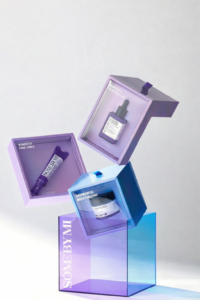
In contrast, the J-Beauty routine presents itself as an act of concentration. Gentle yet highly precise formulations focused on skin health. Four to six steps—no more, but also no less than necessary. Fewer products, fewer stimuli, fewer promises. Instead, conscious reliability:
• Gentle, thorough cleansing (often with high-quality cleansing oil)
• Lotion (a light, hydrating emulsion—not to be confused with European lotion)
• Serum or essence for specific needs
• Emulsion or cream
• Consistent sun protection with aesthetically pleasing texture
Here, care becomes an intelligent ritual. Few steps, gentle consistencies, mindfulness, resilience. The massage during application is as important as the product itself. It is about emphasizing texture and sensuality, the longevity of results, and respect for natural rhythm. J-Beauty in the Slow concept cultivates the silence of the skin.
Less is more—not from lack, but from wisdom. J-Beauty understands that quality cannot be replaced by quantity.
The Products: Between Sensation and Substance
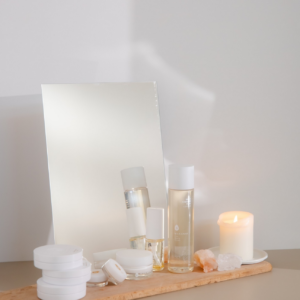
An interesting linguistic aspect separates Asian from European cosmetics: What is called ‘serum’, ‘lotion’ or ‘essence’ in Korea and Japan often corresponds to the European ampoule—highly concentrated active ingredients in precise formulation. But while European dermatology relies on clinically tested individual active ingredients, K-Beauty and J-Beauty follow different principles.
K-Beauty: The Diversity of Innovation
Korean products are characterized by their diversity and experimental spirit:
• Sheet masks in countless variations—from snail mucin to gold and diamond powder
• Essences, boosters and ampoules with novel textures and instant effects
• BB and cushion makeup for seamless perfection
• Sleeping masks for overnight care
• Brightening serums with niacinamide and AHA formulas
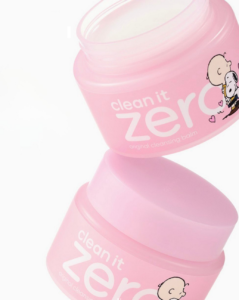
These products often range in the low to mid-price segment, with rapid product turnover driven by influencer marketing and viral, rapidly changing trends. Young branding, colorfulness, eye-catching, playful packaging. It is a democratization of beauty—everyone can experiment, everyone can be part of the trend.
K-Beauty buyers expect novelties, visible short-term effects, appropriate value for money, viral products, influencer-driven hype marketing; they are open to many steps and experiments.
J-Beauty: The Art of Prevention
Japanese products, on the other hand, focus on quality and tradition, Less is More:
• Multifunctional cleansing oils of exceptional quality
• Lotions (light hydrating emulsions) with silky texture
• Highly effective high-tech serums backed by decades of research
• Sunscreen products with superior texture and wearing comfort
• Fermented ingredients like rice and koji, gettou, matcha, camellia extract, 24-carat gold
• Plant oils like camellia oil for natural care
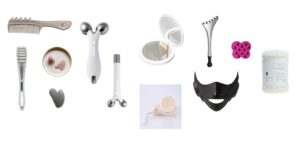
• Ritualized use of beauty tools (cutting-edge technology meets tradition)
These products deliberately position themselves in the premium segment. They are often more expensive, but are the result of decades of research and tradition. The packaging is subtle yet noble and elegant, the communication restrained. It is not about the hype, but about sustainable effect. It is a reverence for the power of nature.
J-Beauty buyers expect quality, subtlety, longevity of results, understated yet noble packaging, traditional ingredients; willing to pay more for premium basics.
K-Beauty scores with mass appeal and popularity. The J-Beauty market, though smaller, is steadily growing with a clear premium niche in pharmacy and luxury channels.
The European Perspective: Science as a Third Way
European, science-based dermatology represents a third path that differs fundamentally from both Asian approaches. Here it is not tradition or trend that rules, but the clinical study, the peer-reviewed publication, evidence-based medicine.
European cosmetics focus on individual, high-dose active ingredients: retinol, vitamin C, peptides, exosomes, hyaluronic acid. Each substance is isolated, tested and formulated in optimal concentration. It is a reductionist, intelligent approach based on the principle: one individual problem, one solution, one active ingredient.
The packaging is functional, the communication scientific. Where K-Beauty entices with Glass Skin and plump Mochi Hada and J-Beauty convinces with centuries-old wisdom, European cosmetics present study results and active ingredient concentrations.
It is the beauty of reason, of measurable results, of dermatological recommendation by authorities.
Three continents, three philosophies: Korea shows, Japan reflects, Europe proves.

The European Market: Between Enthusiasm and Contemplation
Europe finds itself in an interesting position between these two worlds. K-Beauty has conquered the continent with its innovative power. Sheet masks have become an Instagram phenomenon, essences fill the shelves of drugstores, and the 10-step routine has inspired an entire generation of skincare enthusiasts.
At the same time, however, interest in more minimalist approaches is also growing. The movement toward ‘Skinimalism’ and more conscious consumption plays into J-Beauty’s hands. European consumers, tired of the product flood and unsettled by stressed skin barriers, are discovering the elegance of reduction.
J-Beauty is increasingly finding its place in pharmacies and luxury retailers, where an affluent clientele is willing to invest in quality and longevity. The subtle aesthetic and the respectful emphasis on skin health rather than visible perfection appeal to a more mature, conscious target group that understands care.
Market research shows: both approaches are recording growth in Europe. K-Beauty with higher momentum and greater volume, J-Beauty with stable, sustainable growth in the premium niche. It is not an either-or, but a both-and—depending on needs, lifestyle and skin type.
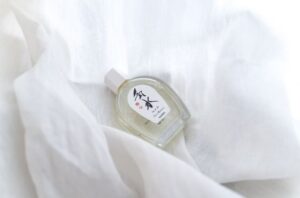
Language Worlds of Care – Serum, Lotion, Essence
A common misunderstanding in the European perception of Asian cosmetics lies in terminology.
In Asia, they mean:
• Lotion not a light cream, but a thin, moisture-providing liquid (comparable to a hydrating toner, but highly effective)
• Essence a very fine active ingredient solution
• Serum often what is understood in Europe as an ampoule
The European ampoule—highly concentrated, used short-term—finds its counterpart in Asian serums or ampoules. The difference lies less in the content than in the ritual of application: in Asia, these textures are gently layered, not applied in targeted courses.
The Wisdom of Choice
In the end, the question is not which approach is ‘better’, but which suits us. K-Beauty teaches us that experimental spirit and innovation have their place, that visible results can motivate, and that creative skincare can be fun. The danger lies in overload, in the constantly new that displaces the proven.
J-Beauty, on the other hand, reminds us that less is sometimes more, that quality triumphs over quantity, and that true beauty takes time. The challenge lies in mustering the patience for long-term results in a world of fast consumption.
European science-based dermatology offers a third way: evidence-based, precise, personalized, without cultural romance, but with the promise of measurable results.
Perhaps the greatest wisdom we can draw from this comparison is that there is no one right way. Our skin is as individual as we are. It deserves to be treated with mindfulness—whether with ten steps or four, with the latest trend or proven tradition, with Asian elegance or European science.
Beauty lies not in the method, but in respect for one’s own skin—and in the wisdom of knowing what it truly needs.
In the end, skincare is a highly personal journey. A journey on which we can learn the joy of experimentation from Korea, the art of mindfulness from Japan, and the power of science from Europe. It is the synthesis of these worlds that can lead us to the best version of our skin—healthy, cared for, and in balance.
Beauty at Healthy Pleasures – What It’s Really About
We at Healthy Pleasures believe in a new kind of beauty—Unhurried. Unfiltered. Uncompromising.
It’s not about striking beauty images or polished perfection. But the conscious, the elemental.
Beauty as the sacred pause. A quiet return to the essential. A mindful gaze. The sensitivity of perception. We don’t need to prove or correct anything—let us simply be present. It is enough.
Every product we represent is a conversation, a reminder, a return. Every product tells a story—not of mass production, but of patience, presence and purpose. Handcrafted in small batches, each creation is made with care—filled with the intention of its makers and the wisdom of the earth.
Skincare should feel human. Thoughtful. Honest.
That’s why we don’t chase beauty. We create meaning.
We believe in brands where consciousness meets craftsmanship—where every product is chosen with intention, not hype. Created by visionary makers who believe that integrity is luxury. Because: Beauty is not consumed. It is a ritual that shapes truth and where intention becomes art.
Beauty is not born in factories—it is cultivated in silence, where science meets soul.
Beauty is born in the heart.
This is what we stand for. And this is what we want to share with you.