PhD Anna Mazurkiewicz-Pisarek
Products containing peptides are increasingly common in the offerings of many cosmetic brands. The diversity of peptide names in INCI lists and their declared functions pose a challenge even for experienced specialists, as individual compounds differ not only in structure but primarily in their mechanism of action, which directly influences their applications and recommendations for specific skin types and age groups.
Some of these substances may come from uncontrolled sources and fail to meet purity standards, limiting their effectiveness. So, what exactly are peptides, what roles do they play in cosmetics, and how can you choose the best one?
Biomimetic peptides are synthetically produced molecules that mimic natural peptides found in the human body—such as neurotransmitters, hormones, growth factors, or inflammatory mediators. In cosmetology, they are primarily used for anti-aging, reparative, and moisturizing purposes. Their popularity is not merely a passing trend but the result of years of scientific research confirming their efficacy and safety.
The mechanism of action of biomimetic peptides depends on their type, structure, and therapeutic target. Generally, three main groups are distinguished:
- Signal Peptides
This is the most widespread group, stimulating skin cells to produce collagen, elastin, and glycosaminoglycans. They act as “instructions” reminding fibroblasts of their youthful activity. The most well-known example is Matrixyl (e.g., Palmitoyl Pentapeptide-4), which promotes repair processes and improves skin elasticity. - Carrier Peptides
Their role is to facilitate the penetration of active ingredients into deeper skin layers. They act as “vehicles” for metal ions such as copper, essential for enzymatic processes in the skin. A good example is the GHK-Cu peptide (glycyl-histidyl-lysine tripeptide), which has strong regenerative and anti-inflammatory effects. - Neuromodulatory Peptides (Neurotransmitter Peptides)
These peptides block the release of acetylcholine at neuromuscular synapses, reducing the tension of mimic muscles. Their effect resembles that of botulinum toxin (Botox), but in a gentler and fully reversible manner. A popular example is Argireline (Acetyl Hexapeptide-8), which reduces expression wrinkles around the eyes and forehead.
Although cosmetic manufacturers offer a wide range of peptide-containing products, peptides themselves differ significantly in function, purpose, and—most importantly—quality, which directly affects their results. Many substances on the market are sourced from unverified suppliers prioritizing low cost over quality. Choosing such products risks not only failing to achieve promised effects but also poses real threats to skin health due to the presence of impurities.
The use of peptides in cosmetic formulations also requires specialized technological expertise, as peptide structures can be extremely sensitive to the presence of other cosmetic ingredients. A peptide with a damaged structure cannot function effectively, making expert formulation critical to ensure peptide stability.
Both the efficacy and safety of biomimetic peptides depend on their ability to penetrate the stratum corneum. Most peptides do not naturally penetrate deeply, so various strategies are employed to enhance bioavailability, such as:
- Modified chemical structure – for example, the addition of fatty acid residues (palmitoylation) to increase lipophilicity and penetration ability.
- Use of delivery systems – such as liposomes, nanocapsules, or mesosomas.
- Application of penetration enhancers.
Currently, many brands worldwide offer peptide-containing cosmetics in both premium and more accessible segments. However, expectations continue to rise for new generations of peptides—more stable, effective, and selective. Biotechnological production techniques, such as recombinant peptide expression in bacterial systems (e.g., E. coli), are increasingly used, ensuring high purity and product consistency while preserving natural resources.
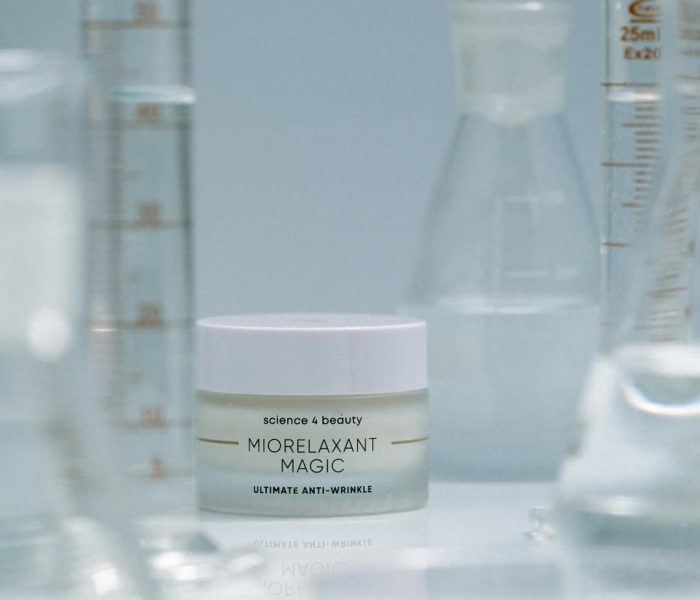
Among the growing market of biomimetic peptides stands out a unique ingredient developed by the brand Science4Beauty — Miorelaxant Magic™. This is a recombinant conotoxin—a peptide whose mechanism of action is based on blocking ion channels located in skeletal muscles. As a result, it directly affects muscle contraction processes, inducing relaxation and reducing tension.
Importantly, Miorelaxant Magic™ does not act on neurons nor block acetylcholine release, distinguishing it from classical neurotoxins used in aesthetic medicine. Its action focuses exclusively on skeletal muscles, producing skin smoothing, wrinkle reduction, and overall facial appearance improvement without interfering with the nervous system.
Compared to other peptides used in cosmetology, Miorelaxant Magic™ is exceptionally effective. Studies involving over 120 volunteers demonstrated that Miorelaxant Magic™ reduces wrinkles around the eyes by 42%, exhibits seboregulating properties (reducing sebum secretion by 57%), and increases skin firmness by 71%1. Additionally, Miorelaxant Magic™ prolongs and enhances the aesthetic effect of botulinum toxin injections (extending the effect by an average of 60 days and improving aesthetic outcomes by 39% according to independent aesthetic medicine experts)2. Its biotechnological production guarantees molecular purity and stability, ensuring predictable and lasting cosmetic results.
¹ Application study report No. S4B_001 – anti-wrinkle activity assessment around the eyes on 60 volunteers aged 25–55; studies conducted at Self Esteem Aesthetic Clinic by Dr. Agnieszka Lew-Mirska and Dr. Przemysław Styczeń – Aesthetic Medicine Clinic, Warsaw.
² Study “Assessment of the efficacy and safety of MIORELAXANT MAGIC cosmetic product in patients undergoing botulinum toxin treatment to reduce wrinkles around the lateral eye corner.” K-LAB Research & Development, Dr. Paweł Kubik, MD.
Moreover, the innovative mechanism of action targeting ion channels in skeletal muscles opens wide application possibilities—from muscle-relaxing products to anti-wrinkle creams and skin-firming formulations. Such targeted effects are difficult to achieve with traditional peptides, which often act more generally and less precisely.
In Science4Beauty’s portfolio, innovative peptides inspired by conotoxins—natural compounds produced by marine cone snails of the genus Conus—play a key role. Instead of harvesting these substances from natural environments, the brand employs advanced genetic engineering methods. The active ingredient is produced via gene expression encoding the peptide in a laboratory-controlled E. coli bacterial strain. This ensures the peptide has an identical molecular structure to its natural counterpart but its production does not harm marine populations or coral reefs.
Science4Beauty integrates the latest scientific and technological advancements into product development. Safety and efficacy tests are conducted on artificial skin, aligning with global trends to reduce animal testing. Subsequent application studies on volunteer groups provide reliable data on ingredient performance in real conditions. The brand places great importance on basing every step—from peptide synthesis to efficacy evaluation—on solid scientific foundations and rigorous quality standards.
It is also worth highlighting that the innovations developed by Science4Beauty have been submitted for patent protection, confirming their uniqueness and providing assurance that the solutions are grounded in real scientific and technological advances. This enables the brand to build trust among specialists and discerning consumers seeking modern, effective, and responsible skincare products.
Safety and Sustainability
The production of Miorelaxant Magic™ relies on advanced biotechnological processes that minimize environmental impact. Because the peptide is obtained through genetic expression in bacteria, there is no need to harvest raw materials directly from marine organisms that could be overexploited. Thus, Science4Beauty combines cosmetic efficacy with ecological responsibility and ethical considerations.
Summary
In recent years, the cosmetics industry has undergone significant transformation. Increasingly, consumers receive products based on real scientific achievements rather than empty promises. Biomimetic peptides are among the most fascinating examples. These peptides not only improve the appearance of the skin but also truly influence its cellular function—exemplified best by Science4Beauty’s Miorelaxant Magic™.
Biomimetic peptides represent the future of cosmetology, offering precise, safe, and effective skincare solutions that support the skin’s natural regenerative processes. Thanks to modern production methods such as genetic recombination, we have access to advanced, high-quality active ingredients.
A unique example is Miorelaxant Magic™—a peptide blocking ion channels in skeletal muscles, providing wrinkle smoothing and muscle relaxation through an innovative mechanism without affecting the nervous system. Its biotechnological production guarantees quality, safety, and sustainability.
Such solutions set new standards in the cosmetics industry by combining science, technology, and natural inspiration, enabling the creation of products that meet the needs of today’s consumers who seek innovation and conscious choices.
https://www.mdpi.com/2079-9284/10/4/111
https://www.mdpi.com/2073-4360/17/6/798