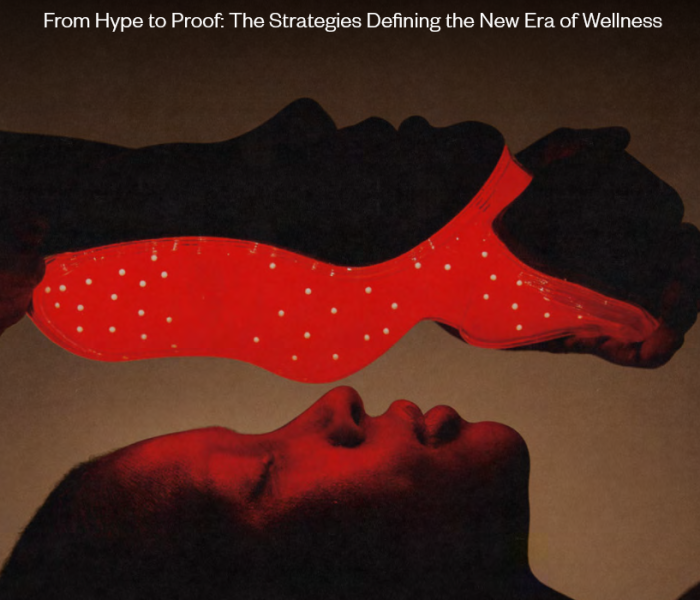
From biohacker obsession to mainstream force: what the longevity shift means for beauty, wellness, and brands
Longevity has crossed a threshold. What began as a pursuit of billionaires and biohackers has become a structural force reshaping beauty, wellness, hospitality, and luxury — and the pace of change is accelerating faster than most brands anticipated. Global Google searches for “longevity” have tripled in the past year alone. In a survey of 1,000 early adopters across the UK and US, six in ten said they would choose a full-body preventative scan over a luxury spa day.
The Age of Proof
The single biggest shift is the demand for credibility. Consumers — especially Gen Z, with 29% preferring science-led products — are no longer swayed by longevity language alone. Nine in ten early adopters now expect beauty products to deliver proven benefits, and 86% want the same scientific backing they associate with healthcare. A decade ago, investors backed clean beauty and colour cosmetics. Today, capital is flowing into clinical skincare: brands with patented molecules, defensible IP, and published clinical outcomes. Brands that have borrowed longevity’s language without doing the underlying science are running out of runway.
The Gender Gap Is a Commercial Opportunity
The longevity market has been built predominantly on male biology — a structural bias that now represents one of the most significant untapped opportunities in the category. Although women outlive men by more than five years on average, they spend 25% more years in poor health as a result. Half of women surveyed (49%) now cite hormonal wellbeing as a growing priority. The Gates Foundation is investing $2.5bn by 2030 in women’s health research. The brands that move into this space with genuine scientific grounding have first-mover advantage.
From Products to Protocols
Longevity consumers are not making purchases — they are building systems. They stack supplements, diagnostics, devices, and skincare into daily protocols designed to compound value over time. 67% of early adopters prefer products that deliver benefits over time rather than instant results. 63% would undertake a personalised nutrition plan; 59% would use personalised skincare diagnostics. The winning brands are those that position themselves as an indispensable component of a longer-term system, not a standalone transaction.
Restoration Over Optimisation
A backlash against the quantified self is quietly underway. Switzerland has even identified “longevity fixation syndrome” as a recognised condition. Consumers still want science — but they want it to feel human. Mindfulness and mental wellbeing now rank almost level with longevity itself as consumer priorities (51% vs 52%). Recovery has expanded from athletic performance into a whole-self proposition: thermal experiences, sound bathing, communal rest, and products with documented neuro-cosmetic benefits are all growing fast.
Physical Spaces as Longevity Assets
From Neko Health’s design-forward preventative scan clinics to 113 Spring in New York — a living lab merging luxury, community, and longevity — physical spaces are becoming strategic brand assets in their own right. Retail, hospitality, and clinical environments are converging. Community and belonging, long overlooked, are emerging as powerful drivers of long-term health outcomes.
The Five Strategic Opportunities
The report distills five clear opportunities for brands: own the science (build proof that compounds); bring clinical to life (close the gap between rigour and human experience); lead on women’s longevity (a structurally underserved market); build the system (become an indispensable protocol component); and play the long game (design for every life stage, not just peak spending years).
The bottom line: longevity has changed the question the industry asks. For decades, beauty and wellness asked how to make people look and feel better. Longevity reframes that as how to help people live better, for longer. That is not a product brief. It is a fundamentally different relationship between a brand and a consumer — and the brands that answer it credibly, humanly, and with genuine scientific proof will define the next decade of wellness.